
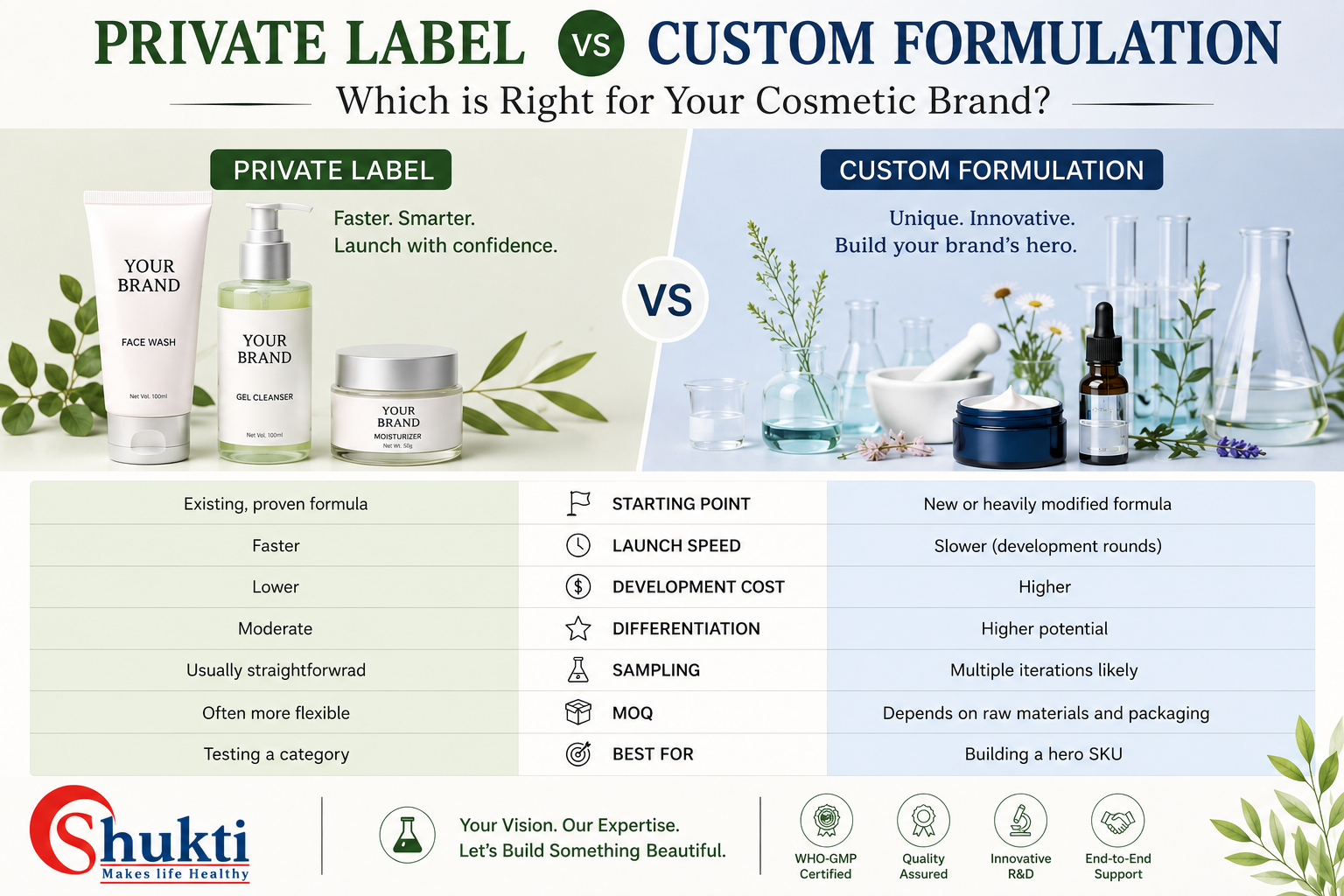
Quick answer: Choose private label if you need to launch fast, keep the initial spend low and find out whether customers actually want the product. Choose custom formulation if you already know your customer, have a clear product gap to fill and need a formula competitors can't copy off a catalogue. Most successful Indian beauty brands do both, private label first to validate, custom R&D later to differentiate.
Neither model is better. They solve different problems, and picking the wrong one usually costs you either speed or money.
The Difference in One Line
Private label starts with the manufacturer's existing formulation and builds your brand around it. Custom formulation starts with your product concept and builds a formula around that.
Everything else, cost, timeline, MOQ, exclusivity, follows from that single difference.
<style>
  .comparison-table-wrapper {
    width: 100%;
    overflow-x: auto;
    -webkit-overflow-scrolling: touch;
    margin: 20px 0;
  }

  .comparison-table {
    width: 100%;
    min-width: 650px;
    border-collapse: collapse;
    font-family: Arial, sans-serif;
    font-size: 16px;
    color: #333;
    background: #fff;
  }

  .comparison-table th,
  .comparison-table td {
    padding: 14px 16px;
    border: 1px solid #ddd;
    text-align: left;
    vertical-align: middle;
  }

  .comparison-table thead th {
    background-color: #f5f5f5;
    font-weight: 700;
    color: #222;
  }

  .comparison-table tbody tr:nth-child(even) {
    background-color: #fafafa;
  }

  .comparison-table tbody tr:hover {
    background-color: #f2f7ff;
  }

  .comparison-table th:first-child,
  .comparison-table td:first-child {
    font-weight: 600;
    width: 25%;
  }

  @media (max-width: 768px) {
    .comparison-table {
      font-size: 14px;
      min-width: 600px;
    }

    .comparison-table th,
    .comparison-table td {
      padding: 12px;
    }
  }
</style>

<div class="comparison-table-wrapper">
  <table class="comparison-table">
    <thead>
      <tr>
        <th></th>
        <th>Private Label</th>
        <th>Custom Formulation</th>
      </tr>
    </thead>

    <tbody>
      <tr>
        <td>Starting Point</td>
        <td>Existing, proven formula</td>
        <td>New or heavily modified formula</td>
      </tr>

      <tr>
        <td>Launch Speed</td>
        <td>Faster</td>
        <td>Slower (development rounds)</td>
      </tr>

      <tr>
        <td>Development Cost</td>
        <td>Lower</td>
        <td>Higher</td>
      </tr>

      <tr>
        <td>Differentiation</td>
        <td>Moderate</td>
        <td>Higher potential</td>
      </tr>

      <tr>
        <td>Sampling</td>
        <td>Usually straightforward</td>
        <td>Multiple iterations likely</td>
      </tr>

      <tr>
        <td>MOQ</td>
        <td>Often more flexible</td>
        <td>Depends on raw materials and packaging</td>
      </tr>

      <tr>
        <td>Best For</td>
        <td>Testing a category</td>
        <td>Building a hero SKU</td>
      </tr>
    </tbody>
  </table>
</div>
Note the phrase "higher potential." Custom formulation creates more room to differentiate. It does not guarantee a product anyone wants to buy.
What Private Label Actually Means
You select from a manufacturer's existing range and sell it under your own brand. You control the name, packaging, labels, positioning and marketing. The manufacturer handles production.
The part founders miss: the amount of customisation varies enormously between suppliers. Some allow changes to fragrance, texture, colour, active percentages, pack size. Others hand you a fixed formula and a blank label.
So the useful question isn't "do you offer private label?" It's:
"What exactly can I change, and does changing it trigger extra R&D, testing or MOQ?"
Ask that early. The answer separates real private label flexibility from a sticker-swap.
What Custom Formulation Involves
Instead of picking from a catalogue, you write a brief. Something like:
"A lightweight SPF 50 sunscreen for oily, acne-prone Indian skin. Matte finish, no white cast, premium feel, target MRP ₹599."
An R&D team then works through: brief → feasibility review → prototype → testing → your feedback → reformulation → approval → production.
Depending on the product, that loop may run several times. A basic moisturiser and an SPF 50 sunscreen are not comparable development projects, sunscreens, actives-heavy serums and hair treatments all demand more rounds and more testing. (We've broken down what that means commercially in our guide to the true cost of manufacturing sunscreen in India.)
This is why custom formulation takes longer. It isn't paperwork, it's lab work.
White Label, Contract, Third-Party: Sorting the Terminology
These four terms get used interchangeably across the Indian market, and suppliers don't define them consistently. Compare the actual scope of work, not the label:
White label, an existing product, existing formula, your branding. Built for speed. Little or no formulation change.
Private label, usually the same starting point, but often with room to modify formula, pack or positioning depending on the manufacturer.
Contract manufacturing, you supply the formula or specification; the manufacturer produces to it. You typically own the formula.
Third-party manufacturing, outsourced production under the manufacturer's established model, often including filling, packaging, batch documentation and compliance paperwork.
Three quick scenarios make the distinction concrete:
You own the formula, they produce it → contract manufacturing.
You pick their product, they brand it for you → private/third-party.
You bring the idea, their R&D builds the formula → ODM/custom development.
The commercial terms live in the agreement, not the service name. Read the contract, particularly the clauses on formula ownership and exclusivity.
When Private Label Is the Right Call
You're launching your first brand and haven't validated demand yet
Speed to market matters more than a unique formula
Capital is limited and you'd rather spend it on marketing than R&D
You want to build a range across categories quickly
You're testing whether a category works before committing
Starting here is not a compromise. It's how a large share of India's successful D2C beauty brands began, and low MOQs make it genuinely low-risk. Our guide on starting a private label cosmetic brand with low MOQs covers the mechanics.
When Custom Formulation Is the Right Call
You have a specific product gap and know exactly who buys it
Your brand positioning depends on the formula itself
You need control over ingredients, texture, finish or performance
Competitors are already selling near-identical catalogue products
Your margins can absorb development and testing costs
Two Expensive Mistakes
Mistake 1: Assuming custom automatically means better. You spend months developing a unique serum. Premium formula, premium pack, premium cost. Then you discover your customer buys at ₹499 and your landed cost makes that impossible. You've built something technically impressive and commercially unviable. A great formula still needs a working unit economic model.
Mistake 2: Assuming private label can't be differentiated. It can, through product selection, formula tweaks, packaging, bundles, positioning, education and customer experience. Plenty of brands win on better positioning + better distribution rather than a novel molecule. Your product doesn't have to be revolutionary for your brand to be.
The Hybrid Strategy Most Brands Should Use
If you want both speed and differentiation, sequence them:
Phase 1, Launch a proven private label product. Phase 2, Collect real data: what customers like, what they return, why they don't repurchase, what price they accept. Phase 3, Write your R&D brief from that data instead of from assumptions. Phase 4, Launch the improved custom formula as your hero SKU.
Move to custom formulation when your hero product has consistent demand, customers are repeatedly asking for the same improvement, competitors look identical, and your margins can fund the R&D. Until then, you're guessing with expensive money.
Cost and MOQ: What to Actually Ask
There's no standard price for custom development. It scales with product complexity, ingredient count, testing requirements, number of sample rounds and packaging.
Request a development quotation separately from the manufacturing quotation. Bundling them hides where your money goes.
On MOQ, a ready private label product is already in regular production, so quantities are often more flexible. A custom product may need new raw materials, dedicated planning and custom packaging. But there's no universal rule that custom always means higher MOQ. Always ask for three numbers: sample MOQ, first production MOQ, repeat order MOQ.
Questions to Ask Before You Sign
On formulation: How many ready formulas are available? Can I modify fragrance, texture or actives? Who owns the final custom formula? Is exclusivity available? How many sample iterations are included?
On testing: What stability, safety, microbiological and packaging-compatibility testing is available, and is it costed separately?
On production: What's the MOQ at each stage? Is packaging included? What's the lead time? Can the formula be scaled without reformulating?
On support: What documentation and batch records do I receive? Who reviews my label claims?
A manufacturer who answers these clearly is easy to evaluate. One who deflects is telling you something too.
Why North India Works for Cosmetic R&D and Manufacturing
Delhi NCR, Haryana, Himachal and the surrounding industrial clusters host most of North India's beauty and personal care manufacturing capacity. But proximity isn't just about logistics, it's about the number of times you can sit in a lab, smell a sample, reject it and ask for round three without losing a week.
For NCR-based brands, a Haryana facility often means easier coordination and cheaper facility visits than a Delhi address. We've compared the trade-offs in Third-Party Cosmetic Manufacturing in Delhi NCR: Why Haryana Can Be the Better Choice.
When shortlisting a private label skincare company in Haryana, look past catalogue size at facility and quality systems, in-house formulation capability, MOQ and lead times, and repeat-order support. You want a partner who can carry you from sample → approval → production → repeat orders → scale.
Shukti Food Pharma runs a GMP-certified facility in Karnal, Haryana (find us on Google Maps), supporting both routes across skincare, haircare and Ayurvedic categories, private label, custom formulation and contract manufacturing under one roof.
Frequently Asked Questions
Is private label cheaper than custom formulation?
Usually, because you skip the development stage. Final cost still depends on MOQ, packaging, product complexity and how much you customise.
Can I customise a private label formula?
Sometimes. Some manufacturers allow changes to fragrance, texture or actives; others offer fixed formulas only. Ask what's changeable and whether it triggers extra testing.
What's the difference between private label and white label?
White label typically means a ready product with your branding and no formula change. Private label often allows more customisation, but definitions vary by supplier, so confirm scope in writing.
What's the difference between contract and third-party manufacturing?
Both are outsourced production. Contract manufacturing usually means producing to a brand-owned formula or specification; third-party manufacturing in India often means production under the manufacturer's own established model.
How long does custom cosmetic formulation take?
It depends on complexity, sample rounds, testing and raw material sourcing. Ask for a product-specific timeline rather than a general one.
Should a startup choose private label or custom formulation?
For most first-time founders, private label first. Validate demand, then reinvest in custom R&D once you have sales data to brief against.
Can I start with private label and develop my own formula later?
Yes, and it's usually the smarter sequence. Launch, learn, then formulate against real customer feedback.
The Bottom Line
The question isn't "which model is better?" It's "what does my brand need right now?"
Need speed → private label. Need differentiation → custom formulation. Not sure → start private label, validate, then move to custom R&D when the data justifies it.
Your first product doesn't have to be your final product. What matters is a manufacturing strategy that lets you launch → learn → improve → differentiate → scale.
Ready to look at existing formulations? Browse our product collections to find a starting range. Already have a product concept or ingredient brief? Request custom SKU R&D and discuss formulation, sampling, testing, MOQ and timelines before committing to production.